


Home Page


Self-System Life Coach Training
Syntegrity: wholeness through the balance of opposites
Self-System coaching is a transformational, integrative approach that sees each person as a living system. This page explains the ideas behind it: what we mean by the Self-System, the principle of Syntegrity at its core, and where it comes from.
What Is Self-System Life Coaching?
Self-System Life Coaching is a transformational and integrative approach to personal and professional development that views each individual as a dynamic living system. At its heart is the concept of Syntegrity, which emphasizes structural balance, coherence, and resilience.
Self-System Life Coaching guides us in aligning our many aspects — including subpersonalities, thoughts, emotions, body, values, purpose, and presence — into an integrated whole, coherent around the Self: our stable, luminous center. By harmonizing these inner dynamics, we cultivate clarity, authenticity, and resilience, enabling us to live with greater coherence and integrity.
No one changes in isolation. Every inner shift ripples into relationships, work, community and the natural world, so the approach fosters an inner compass that always considers the wider systems a client belongs to. The aim is lasting change: a life that reflects one's inner truth and contributes to the systems we all share.

Syntegrity
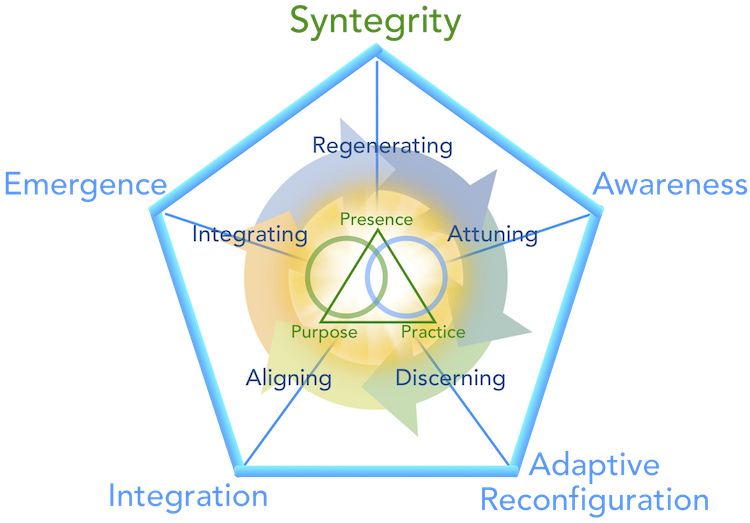
Syntegrity combines synthesis and integrity. It takes its inspiration from tensegrity, Buckminster Fuller's term for structures that hold their shape through a balance of tension and compression: they are stable not despite the opposing forces within them, but because of them.
Applied to people, the principle is simple. Inner tensions are not problems to eliminate. Held in the right relationship, opposing forces such as stability and change, autonomy and connection, doing and being become a source of strength. In Self-System coaching, clients learn to turn tension into balance, paradox into creativity, and intention into sustainable action.

Basic Concepts
What this means for you as a coach
Self-Leadership and its roots

Psychosynthesis: the model of the Self, the will and subpersonalities, and the practice of disidentification.
Systemic thinking: seeing each person within the relationships and systems they belong to.
Positive psychology and neuroscience: what research shows about how people learn, grow and change.
Ecopsychology: the link between personal wellbeing and our relationship with the natural world.
Vedic and contemplative traditions: practices of presence, and a long human inquiry into the nature of the Self.
The entire curriculum is presented within the framework of the ICF Code of Ethics and Core Competencies, the professional structures that keep depth grounded in practice.
The training doesn't hand you a fixed set of techniques or a cookbook of "powerful questions". It develops a way of being with clients that can meet complexity with openness and depth, built on solid professional skills.
You learn to form a transpersonal partnership with your clients: helping them reach their goals while reconnecting with their deeper Self, letting go of identification with passing parts of themselves, and shaping lives that reflect coherence and integrity.
Your own inner work is part of the training. As your presence and awareness deepen, your use of the Core Competencies matures into a Self-guided practice: the move from competence to mastery.
Self-Leadership is the outcome of the approach : the capacity to act from the Self as an inner compass, rather than from whichever part or pressure happens to be loudest.
We write Self with a capital S deliberately. The concept comes from Roberto Assagioli, the Italian psychiatrist who founded Psychosynthesis in the early twentieth century. For Assagioli, the Self is a deeper center of being, of which our everyday "I" or ego is only a reflection. The Self is always present, even when obscured by outside noise and inner fragmentation.
SCA's own roots are there, too. We began by training Psychosynthesis Life Coaches, and the Self-System approach grew out of that work.
Ultimately, this training is more than professional development: it is a transformational journey into the heart of who you are and who you are becoming as a coach. It invites you to embody and radiate the love, clarity, and essence revealed through your own inner work, making these qualities visible and tangible in every coaching session. By combining profound teachings with the rigor of the ICF framework, the program offers a transformative experience that empowers you to enables you to create a lasting and meaningful impact, while remaining grounded in a practical, professional approach.

From competence to Self-Leadership.

Program Outline
Two levels of certification are available, opening the doorway to professional practice at ICF ACC or PCC levels.

Meeting the ICF Level 1 standards, the 80-hour Practitioner program consists of a minimum of 60 hours of live, highly interactive online sessions divided into 5 study modules introducing tools and methodologies of the Self-System framework in a coaching context built on the Core Competencies of the International Coaching Federation (ICF). You will begin coaching practice right away and are expected to complete 15 hours of peer coaching of which 5 will be observed coaching sessions, and your coaching competence will be certified through a final, formal performance assessment. Graduates earn a Practitioner Certificate in Self-System Life Coaching, certifying their abilities as competent, professional coaches. You’ll be solidly grounded in Self-System coaching with a good understanding of the ICF Core Competencies and ready for a fulfilling coaching career.
For those who intend to move ahead with ICF Associate Certified Coach (ACC) credentialing, 10 hours of mentor coaching are required. The Practitioner/Level 1 package includes 7 hours of group mentor coaching performed by an accredited MCS (mentor coach specialization) mentor coach, as an integral part of the training program. The remaining 3 hours of individual mentoring are completed independently outside the SLC program, using an MCS-qualified mentor coach of your choice. If you choose to do the individual mentoring with Synthesis Coaching Associates, your Practitioner/Level 1 Package will provide you the course hours, formal performance evaluation, certification, and mentoring prerequisites necessary for ICF ACC credentialing, all in one convenient package. Should you elect to use an external mentor, you will have the training prerequisites needed to apply for your ACC through the ICF's Portfolio Path.
In addition the Level 1 program will provide you with 7 hours of professional coaching supervision: an indispensable aspect of your emergence as a professional coach.
Coaching hours required for ACC accreditation are up to the coach to complete, as are all other prerequisites.

The 160-hour Self-System Advanced Practitioner program consists of 10 study modules, including and building on the Practitioner curriculum and deepening your skills at applying the Self-System to Transformational Life Coaching, while introducing highly effective coaching tools derived from disciplines including ecopsychology, psychoenergetics, resilience, NLP, Syntegrity, Vedic concepts, Human Systems, aspects of executive coaching, and others.
Students completing this program earn an Advanced Practitioner Certificatein Self-System Life Coaching. You will complete another 15 hours of peer-coaching, 7 of which will be observed sessions, and you’ll have 10 hours of professional coaching supervision. You will also receive training on defining and building your own coaching business, and more.
For those who intend to move ahead with ICF Professional Certified Coach (PCC) credentialing, the Level 2-accredited Advanced Practitioner/PCC Package provides the course hours, formal performance evaluation, certification and group mentoring prerequisites necessary for PCC credentialing. If you elect to do your 3 hours of individual mentoring with SCA, you will also satisfy the performance evaluation/competency review requirements of the ICF. This means when you complete the full Level 2 accredited program you will be eligible to apply for credentials from the ICF using the ACC or PCC Level 2 Applications. These applications do not require your participation in the ICF Performance Evaluation Process, but you will need to pass the ICF coaching knowledge exam and meet the coaching hours requirements.
Coaching hours required for PCC accreditation are up to the coach to complete, as are all other prerequisites.
Home study is supported by on-demand webinars providing additional insights into key elements of Self-System Life Coaching and other coaching skills within the ICF framework. You can see an example here.
Graduates from the 80 hour Practitioner program are professionally qualified as Self-System Life Coach Practitioners. Graduates from the 125 hour Advanced program are qualified as Self-System Life Coach - Advanced Practitioners.
Registration for the Spring 2027 Academic year is now open.
Program Deliverables

SCA’s Transformational Leadership programs are Level 1 and Level 2 Coach Training Programs accredited by the International Coaching Federation. These programs provide you with the training prerequisites you need for the ICF’s new credentialing requirements.
Graduates of the Practitioner Program are certified as Self-System Life Coach Practitioners. Those opting for "ICF Level 1" will have completed group mentoring, and if individual mentoring is done with SCA will satisfy ICF's formal evaluation requirements and are prepared for credentialing as an ICF Associate Certified Coach (ACC) through the Level 1 Pathway provided the coaching hours and other ICF credentialing prerequisites are met.
Graduates of the Advanced program receive professional certification as Self-System Life Coach-Advanced Practitioners. If you have opted for "Level 2" you will have completed group mentoring, and if individual mentoring is done with SCA will satisfy ICF's formal evaluation requirements and are ready to apply for credentials with the ICF as an Associate Certified Coach (ACC) or Professional Certified Coach (PCC) via the ACC or Level 2 Pathway, provided that the coaching hours and other ICF credentialing prerequisites are met.
You will receive certification for all hours of co-coaching (peer-to-peer) carried out during your course of study. As an ICF Accredited Coaching Education Provider, our certification is applicable to both your ICF credential and, depending on the program, any further coaching education you wish to undertake.
Self-System students and graduates are eligible for discounts in SCA's mentoring program which meets the requirements for credentialing or ICF ACC or PCC credential renewal.